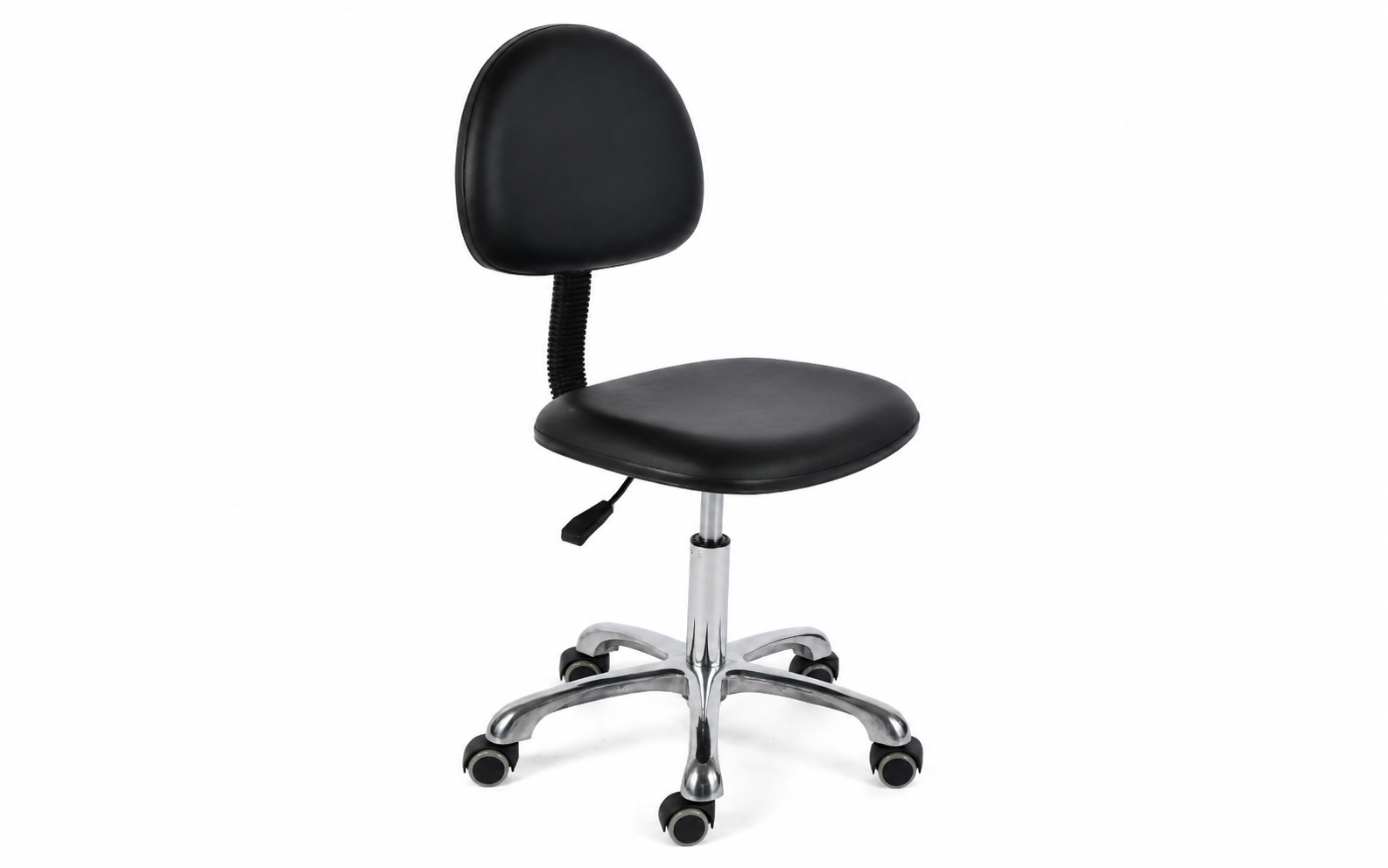
Distributors in Argentina can attract more corporate customers by redesigning laboratory chair displays around business applications instead of arranging products as a row of isolated models. Corporate buyers rarely make decisions based only on appearance; they want to understand whether a chair fits the workstation, supports different users, matches the floor, allows practical movement, and can be maintained over time. A stronger display begins with clearly defined scenarios such as pharmaceutical analysis, university teaching, industrial quality control, food testing, clinical diagnostics, and shared research. Each scenario should include a representative bench height, instrument position, floor type, storage clearance, and short explanation of the operational problem being solved. When presenting an industrial polyurethane with chrome foot ring and casters adjustable laboratory chair, the display should demonstrate how the seat height aligns with an elevated bench, how the ring supports the user’s feet, how the casters behave during short movements, and how the polyurethane surface can be cleaned in routine work. Argentine distributors can add dimension cards, application notes, load information, adjustment ranges, and compatible replacement-part references beside the chair so procurement and facility teams can collect decision-ready information without waiting for a salesperson. The showroom should also encourage interaction. Buyers should be able to adjust the chair, test the movement, compare it with a lower model, and observe the space required around the base. This turns the display into a practical evaluation environment rather than a decorative presentation. By organizing products according to customer tasks and business outcomes, distributors make it easier for corporate visitors to identify the right configuration, discuss internal requirements, and justify the purchase to other decision makers.
Digital and mobile displays can extend this application-led experience to corporate buyers who cannot visit a central showroom. A professional product page should combine clear photography, short videos, 360-degree views, dimensional diagrams, downloadable specifications, configuration choices, delivery information, and a focused B2B inquiry form. The page should not repeat generic claims; it should answer questions about bench compatibility, user rotation, movement, maintenance, spare parts, and project support. For an industrial polyurethane with chrome foot ring and casters adjustable laboratory chair, distributors can create a short demonstration video showing adjustment, foot-ring positioning, caster movement, and fit at an elevated workstation. Interactive comparison tools can help visitors compare seat materials, bases, casters, glides, and height ranges without opening multiple catalogs. Argentine distributors can also build sector-specific landing pages for pharmaceutical plants, universities, healthcare laboratories, food processors, mining operations, and industrial manufacturers, using local application language and calls to action such as request a sample, schedule a site review, download a specification, or ask for a project quotation. Mobile demonstration programs are equally valuable for reaching companies in other cities. A compact display kit can include one or two representative chairs, floor samples, measurement tools, printed checklists, and QR codes linking to digital content. Sales teams can take this kit to customer sites, regional dealer events, technical conferences, and contractor meetings. The goal is to let buyers evaluate the chair in the real environment while capturing structured feedback. Every mobile display should lead to a documented next step, such as sample approval, technical review, or commercial proposal. This ensures that product demonstrations produce measurable B2B opportunities rather than informal interest.
The most effective product display strategy connects visual presentation with proof, lead qualification, and follow-up. Corporate buyers want evidence that the distributor can deliver consistent products, preserve approved specifications, and support the chair after installation. Displays should therefore include customer references, sample evaluation summaries, warranty procedures, service-response standards, spare-parts maps, and examples of room-based delivery or phased project support. If an industrial polyurethane with chrome foot ring and casters adjustable laboratory chair is featured, the display can show the exact component breakdown and explain which parts can be replaced, which options are approved, and how the distributor records the configuration for future repeat orders. Argentine distributors should use QR codes or tablets to capture the visitor’s company, sector, city, project stage, expected quantity, workstation height, and next action. This information can flow directly into the CRM, triggering a tailored follow-up rather than a generic sales email. Management should measure display performance through visitor-to-inquiry rate, inquiry-to-sample rate, sample-to-quotation rate, average project value, and repeat-order potential. Underperforming displays can then be improved by changing the scenario, message, proof, or call to action. Original Google-friendly content based on the same display themes—such as laboratory chair demonstrations, workstation compatibility, sample evaluation, and corporate procurement planning—can attract buyers before they ever meet a salesperson. By combining application scenarios, interactive evaluation, digital tools, mobile demonstrations, credible proof, and disciplined follow-up, distributors in Argentina can turn laboratory chair displays into a powerful B2B sales asset that attracts more corporate customers and shortens the path from interest to purchase.
READ MORE