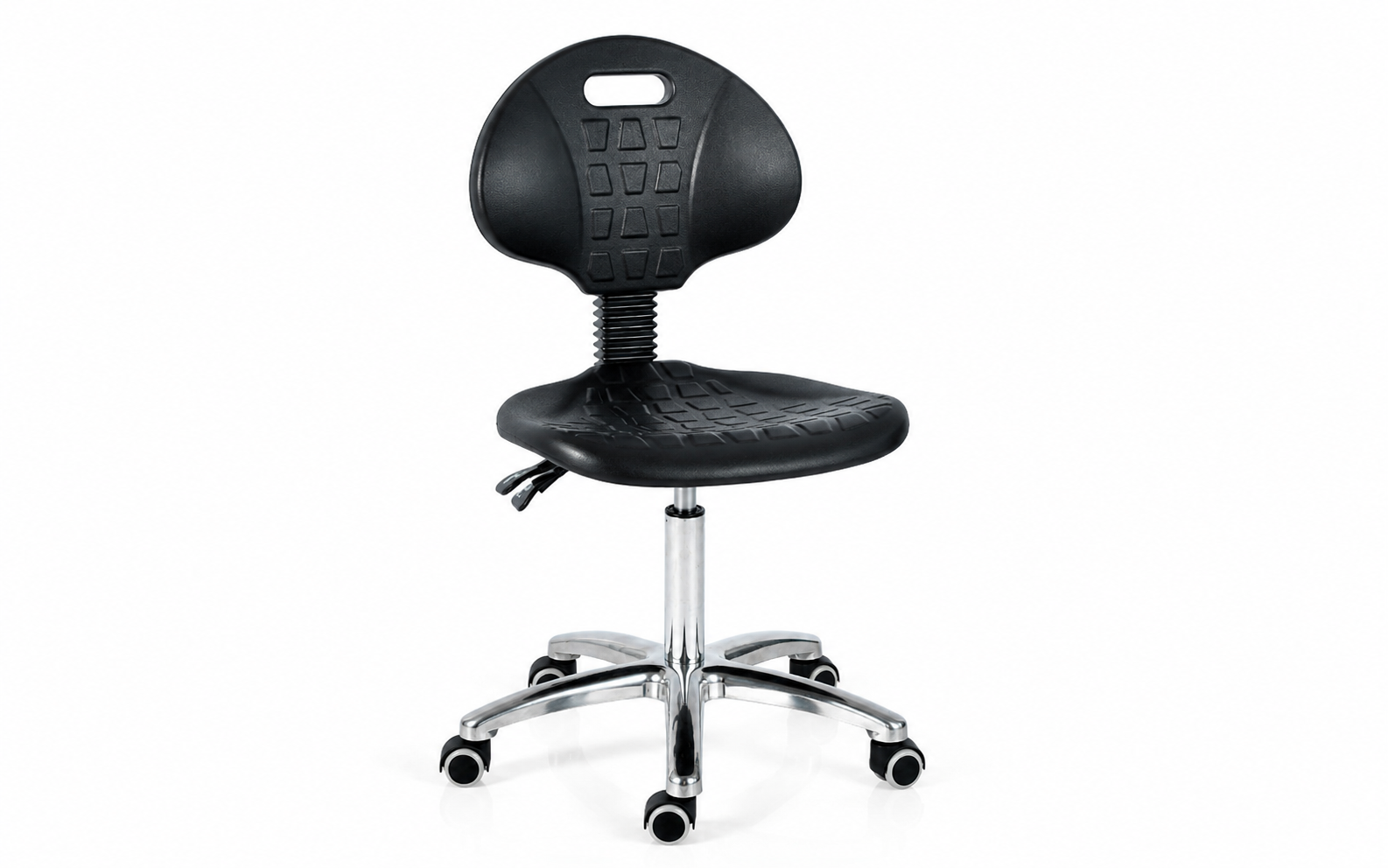
Companies in Argentina are paying more attention to laboratory chair comfort because employee efficiency is increasingly understood as the result of many small workplace conditions acting together over an entire shift. In laboratories, users may alternate between microscopes, computers, instruments, sample preparation, documentation, and quality checks, often while working at benches that differ from standard office desks. When a chair does not match the workstation, employees may repeatedly reposition themselves, lean forward, move away from the task, or stand unnecessarily to relieve discomfort. These interruptions may appear minor, but across several employees and multiple shifts they can reduce concentration, slow routine procedures, and create inconsistent working habits. For this reason, B2B buyers are examining whether seating supports the actual task rather than simply whether the chair looks modern. Height adjustment, stable foot support, seat dimensions, surface material, base size, mobility, and clearance under the bench all influence how easily a user can maintain a practical working position. An industrial polyurethane with chrome foot ring and casters adjustable laboratory chair can be evaluated for elevated workstations where users need a cleanable seat, controlled movement, and a place to support their feet while changing position. Argentine distributors can add value by observing how employees enter and leave the workstation, how frequently they move between nearby instruments, and whether the chair height and foot-ring location suit different body sizes. This application-based review helps companies connect comfort with operational outcomes such as fewer unnecessary movements, smoother task transitions, better visual access to equipment, and more consistent posture during precision work. Instead of treating comfort as a subjective preference, laboratories can define it through workstation fit, task support, and the employee’s ability to remain focused without repeatedly adjusting the environment.
The growing interest in comfort is also related to workforce flexibility and shared laboratory environments. Many Argentine companies use rotating shifts, multidisciplinary teams, temporary project staff, students, technicians, and visiting researchers, which means one chair may serve several people with different heights, habits, and responsibilities. Fixed or poorly adjustable seating forces each user to compromise, while a suitable adjustable chair allows the workstation to be reset quickly. This can improve efficiency at the beginning of a shift and reduce the informal modifications employees often make with boxes, improvised foot supports, or unsuitable cushions. When considering an industrial polyurethane with chrome foot ring and casters adjustable laboratory chair, buyers should test how easily users can change seat height, position their feet, move within the workstation, and return the chair to a stable working position. A structured sample trial can include employees from different departments and shifts, with feedback recorded on adjustment speed, bench access, movement, surface comfort, and perceived fatigue after typical tasks. The purpose is not to select a chair through popularity voting, but to identify whether the configuration supports the widest realistic user range without creating new workflow problems. Argentine distributors can prepare a simple evaluation matrix that compares user groups, workstation types, and task durations, then translate the findings into a clear B2B recommendation. This process is more persuasive to procurement and finance teams because it links comfort to measurable operating conditions rather than vague claims. Companies can also compare error rework, task completion consistency, user complaints, and time spent changing or avoiding unsuitable chairs before and after a controlled upgrade. While seating alone cannot determine productivity, a better-matched chair can remove avoidable friction from repetitive laboratory work and help employees use their attention on the procedure instead of the workstation.
Comfort is becoming a purchasing priority because companies are also looking at retention, workplace quality, and total operating value. Laboratories compete for skilled technicians, analysts, researchers, and quality professionals, and the physical environment contributes to how employees judge the organization’s professionalism and concern for daily working conditions. A well-planned seating upgrade can therefore support both operational and human-resource goals, particularly when it is combined with clear user guidance and consistent maintenance. If an industrial polyurethane with chrome foot ring and casters adjustable laboratory chair is selected for a defined application, the distributor should preserve the approved specification, provide adjustment instructions, identify compatible spare parts, and support future expansion with the same configuration. This continuity prevents a laboratory from returning to a mixed collection of chairs with different heights, mechanisms, and maintenance requirements. B2B buyers should evaluate the complete service package, including sample support, technical documentation, delivery reliability, warranty response, and the availability of replacement casters, gas lifts, rings, seats, or bases. Argentine distributors can further differentiate themselves by offering post-installation reviews that ask whether employees are using the adjustments correctly, whether movement remains suitable for the floor, and whether any department requires a different configuration. They can turn these practical findings into original Google-friendly content about laboratory chair comfort, employee efficiency, shared-user adjustment, elevated bench seating, fatigue management, and workplace modernization. Such content attracts serious buyers because it addresses real management questions rather than repeating generic product descriptions. For companies in Argentina, the business case for comfortable laboratory seating is ultimately about reducing avoidable disruption, supporting consistent work, improving the employee experience, and protecting the value of skilled labor. When comfort is evaluated through task fit, user diversity, lifecycle support, and measurable feedback, laboratory chair procurement becomes a strategic workplace decision rather than a low-priority furniture expense.
READ MORE