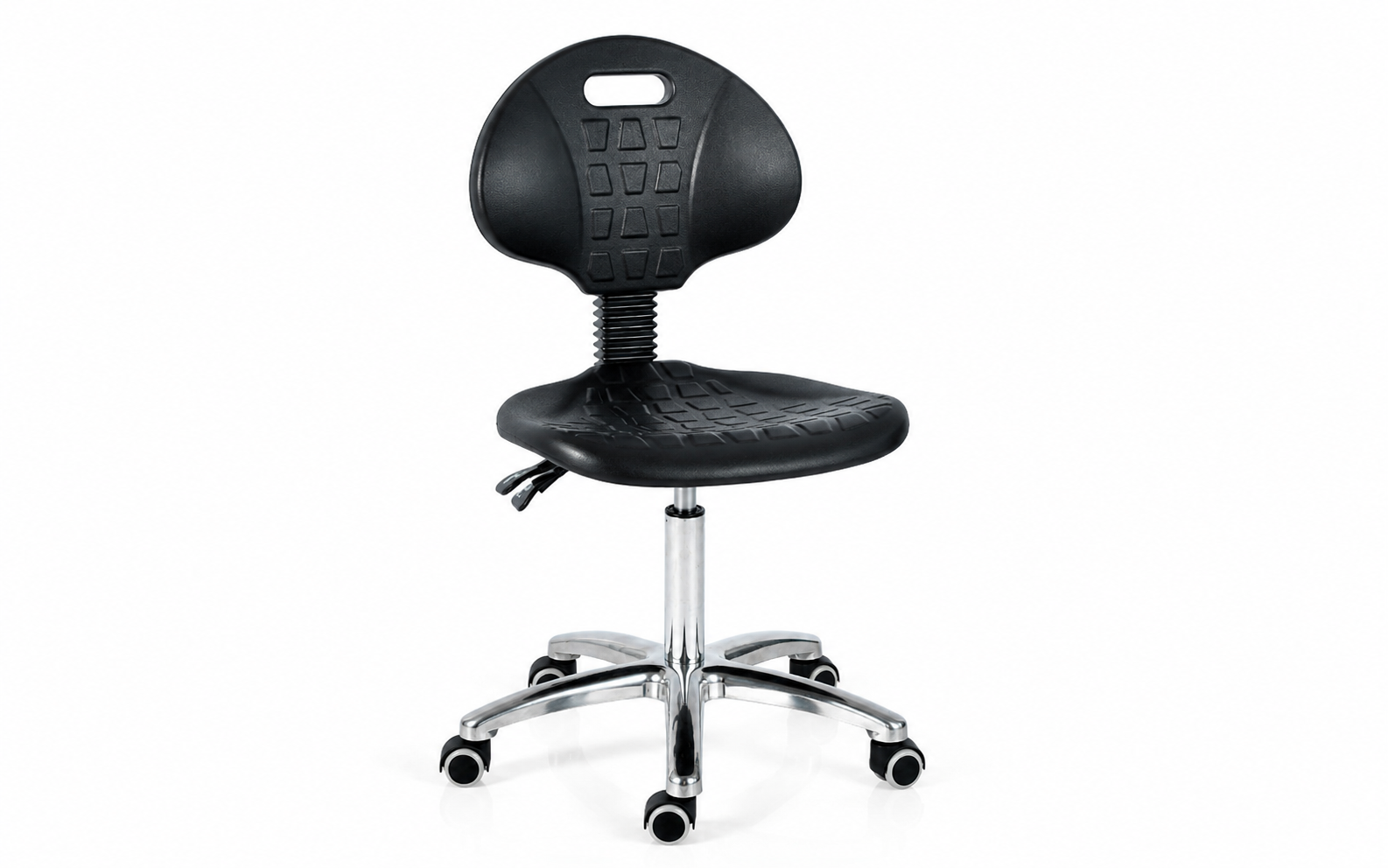
Distributors in Argentina can attract more B2B customers by repositioning laboratory chairs from generic furniture items into application-specific business solutions. Many product pages and sales presentations still focus on isolated features such as seat material, height adjustment, casters, or color, but buyers in pharmaceutical companies, universities, hospitals, food laboratories, industrial quality-control departments, and research centers are usually trying to solve a broader operational problem. They may need to standardize several workstations, reduce replacement frequency, improve mobility between instruments, support rotating users, or prepare a new laboratory for inspection and opening. Repositioning begins by identifying these business situations and connecting each product to a clear outcome. Instead of presenting an industrial polyurethane with chrome foot ring and casters adjustable laboratory chair as a list of components, the distributor can position it as a practical seating solution for elevated benches, shared work areas, and environments where easy surface maintenance and controlled movement matter. This changes the conversation from “What does the chair include?” to “Which workflow does this configuration improve?” Argentine distributors should develop distinct value propositions for different customer groups. A university may respond to durability, multi-user adjustment, and repeatable campus standards; a pharmaceutical plant may value documentation, consistency, and after-sales traceability; a contractor may prioritize dimensional certainty, delivery coordination, and fewer installation surprises. The same product can therefore be presented through different commercial narratives without changing the specification. Distributors should also review their catalogs and websites to remove vague claims and replace them with application examples, decision criteria, and evidence. Original sector pages, workstation diagrams, comparison tables, and short case-based explanations are more useful for Google search visibility because they answer real buyer questions. A strong repositioning strategy makes the product easier to understand, easier to justify internally, and easier to compare on value rather than on price alone.
The second step is to package the product around proof, service, and purchasing confidence. B2B customers are more likely to engage when they can see how a supplier will reduce risk throughout the procurement process. Distributors can create solution bundles that combine the chair with sample trials, technical review, room planning, delivery scheduling, spare-parts recommendations, and post-installation support. When offering an industrial polyurethane with chrome foot ring and casters adjustable laboratory chair, the commercial package might include a bench-height compatibility check, caster selection guidance, a documented trial form, approved configuration records, and a replacement-parts list. This bundle is more persuasive than a low unit price because it helps procurement, facilities, laboratory management, and finance understand the total value of the offer. Argentine distributors can also reposition products by creating good-better-best structures based on application complexity rather than simply adding more features. One option may serve standard laboratory tasks, another may support higher benches and shared users, and a premium option may include stronger documentation, faster delivery, or extended service. This helps buyers choose according to operational need and budget while avoiding confusing catalogs with too many similar models. Proof should be visible at every stage: clear dimensions, user-load information, sample results, customer references, warranty procedures, delivery performance, and service response standards. Sales teams should be trained to ask diagnostic questions before recommending a model, because a consultative conversation reinforces the new positioning. They should know how to explain why one base, caster, or height range fits a specific environment and when another configuration would be more suitable. Honest recommendations create credibility and improve long-term account value. Repositioning therefore requires more than new marketing language; it requires the distributor’s technical process, sample system, quotation structure, and after-sales service to support the promise being made.
The final stage is to turn repositioning into a repeatable go-to-market system across digital channels, dealer networks, and direct sales. Argentine distributors should define a small number of strategic market positions and apply them consistently in SEO content, sales decks, email campaigns, showroom demonstrations, dealer training, and account meetings. For example, one position may focus on laboratory standardization, another on elevated-workstation performance, another on rapid project deployment, and another on lifecycle support. When an industrial polyurethane with chrome foot ring and casters adjustable laboratory chair is used within these campaigns, the product should appear in a relevant business context rather than as an isolated catalog item. A landing page for industrial laboratories can emphasize durability, mobility, and replacement continuity; a page for universities can focus on shared users, repeat procurement, and multi-room consistency; a page for contractors can highlight dimensions, delivery sequencing, and specification control. Distributors should measure which position generates the strongest inquiry quality, sample conversion, quotation value, and repeat orders, then refine messaging based on data. Dealer partners should receive ready-to-use sector materials, lead-qualification questions, and approved product stories so the brand is presented consistently across regions. Account-based campaigns can target selected Argentine organizations with customized content tied to current expansion, modernization, or standardization plans. Original Google-friendly articles on laboratory seating strategy, workstation compatibility, total ownership value, and procurement risk can attract buyers earlier in the decision process and give sales teams useful follow-up material. The objective is not to make the product sound more complicated; it is to make its relevance clearer. By repositioning laboratory chairs around specific business outcomes, credible proof, and professional service, distributors can differentiate themselves from price-driven sellers, attract more qualified B2B customers, and build a stronger market position that supports larger projects, better margins, and long-term growth across Argentina.
READ MORE